

Cardojo guide · Importing from Japan
Every car sold at a Japanese auction is inspected and written up on one page. Learn to read that page and you will know more about a car than any photo can tell you: its grade, every scratch and dent, its mileage, how it was used and what the inspector noticed.
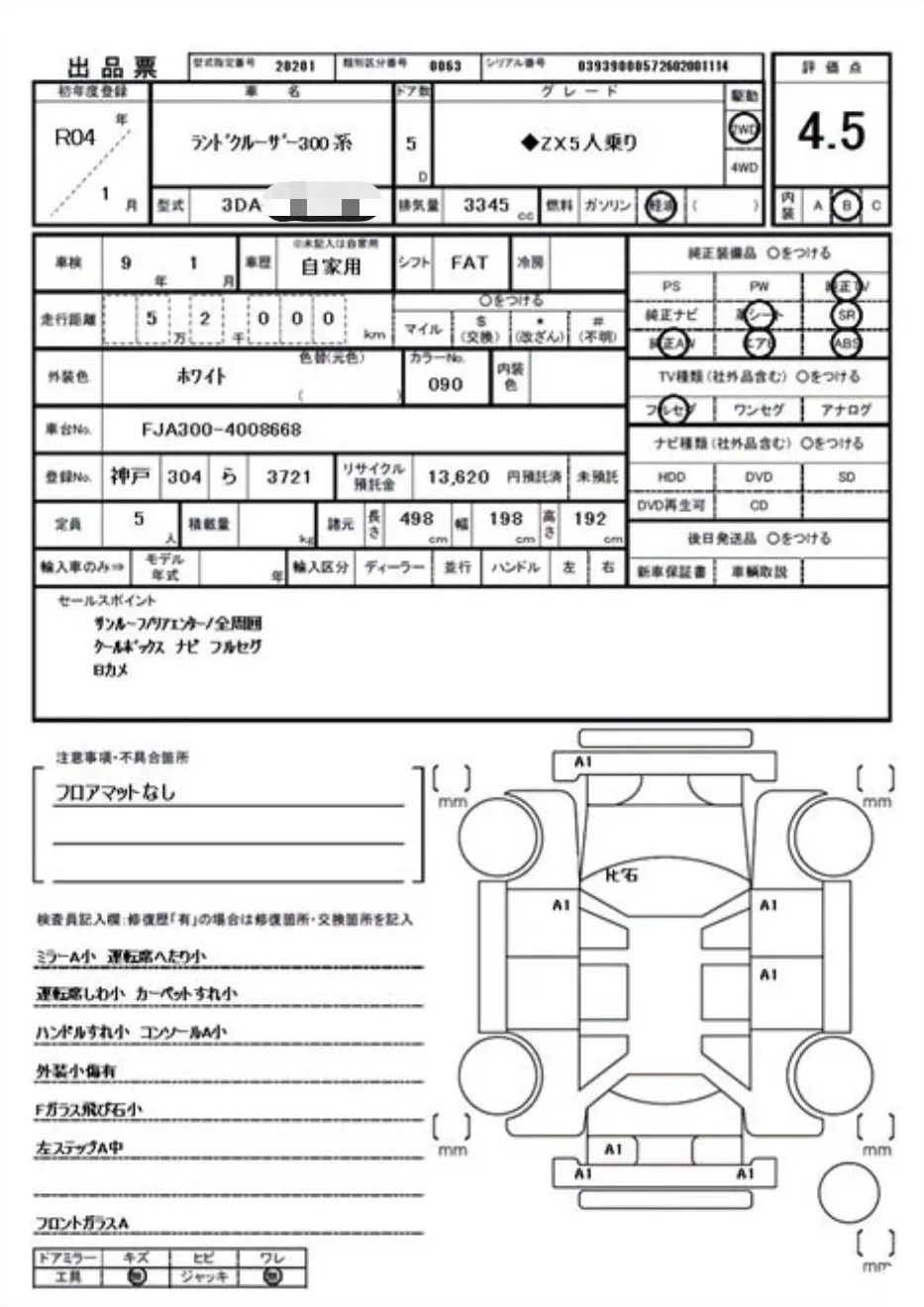 Open full size
A real sheet, read
Toyota Land Cruiser 300 ZX, 2022, diesel
Our reading: a clean, low-mileage car. Price in a set of mats and a touch-up on the step.
01 Start here
You do not need to understand every box on the first read. Look at these four, in this order, and you will know whether a car is worth a closer look.
The big number in its own box. 4 or more is a good car; R means it has been repaired after an accident.
Does the reading suit the car's age and its interior letter? Look for any note that the reading cannot be trusted.
Which panels carry a code, and how big the number is. A replaced pillar matters far more than a scratched bumper.
The handwritten lines. Smells, leaks, noises and repairs are written here and nowhere else.
02 The basics
When a car goes into a Japanese auction, the auction house's own inspector walks round it, looks underneath and inside, and fills in a standard form before the sale. Buyers bid on that form, so the inspector has no reason to flatter the car.
03 The layout
Layouts vary a little between auction houses, but every sheet carries the same nine things. Tap a number on the sample to see what that part tells you.
The lot number and the day it was sold. Together with the auction house they find the original record. More
Model, year, type code and chassis number. The chassis number on the sheet must be the one stamped on the car. More
One number for the whole car, mostly its body. The first thing to read. More
A letter for the cabin and, at some houses, one for the paintwork. A is the best. More
The odometer on the day, often in thousands of kilometres: 32 千km is 32,000 km. More
Who used the car (private, company, rental) and when its Japanese road inspection runs out. More
Short codes for what the car has. The ones it really has are circled or ticked. More
The car drawn from above with its sides folded out, and a code on every panel that has a mark. More
The inspector's own handwriting. The most useful lines on the sheet. More
04 The headline number
The grade sums up the car's condition, and it is mostly about the body. Mileage and age pull it down a little; the engine, the gearbox and the interior hardly move it. Read it as a quick sort, then read the rest of the sheet to find out why.
05 Inside the car
The cabin gets its own letter, next to the grade, because a straight body can hide a worn interior. Most auction houses run from A to D, and some add an E. Look for A or B; C is tolerable too, and worth considering when the price allows for a deep clean.
Excellent: as new, with no visible wear
Look forGood: light wear for the car's age, may need a clean
Look forAverage: some marks, stains, small burns or worn areas; needs cleaning
TolerablePoor: noticeable damage, stains or smells; needs repair and cleaning
Very poor: heavy damage throughout; needs extensive repair
06 The body map
The map is the car seen from above with its sides folded out flat, so every panel shows. Each mark gets a letter for what it is and usually a number for how big it is: 1 is small, 3 is large, and some houses go to 4 or 5.
| Code | Means | What the number adds |
|---|---|---|
| A | Scratch キズ | A1 small (2 to 3 cm), A2 up to 10 cm, A3 longer than 10 cm |
| U | Dent ヘコミ | U1 a small dimple, U2 up to 10 cm, U3 larger |
| B | Dent with a scratch; some houses use B for a plain dent | B1 small to B3 large |
| AU | Scratch and dent together | The number gives the size, as for A and U |
| E | Dimples, small dings | E1 a few, E2 several, E3 many |
| W | Wave or repair mark 修理跡 | W1 Repainted: a repair mark or paint ripple you can barely see W2 Repainted: a repair mark or paint ripple you can see W3 Repainted: an obvious repair mark or ripple, may need repainting |
| S | Rust サビ | S1 surface rust, S2 heavy rust |
| C | Corrosion 腐食, rust that has eaten into the metal | C1 corrosion, C2 heavy corrosion |
| P | Paint damage; the panel needs paint | Usually no number |
| H | Paint faded | Usually no number |
| Y | Hole or crack 穴 · 割れ | Y1 small, Y2 medium, Y3 large |
| X | Needs replacing 要交換 | No number: the part is past repair |
| XX | Already replaced 交換 | No number: look at which panel it is |
| G | Stone chip in the glass 飛び石 | Sometimes with a size |
07 Often missed
They sit on the same map, and they cost real money to put right.
G is a stone chip, which can spread into a crack. An X on the windscreen means it is cracked and must be replaced.
Scratched alloys are marked like any panel. 社外アルミ means aftermarket alloy wheels, not the ones the car left the factory with.
Some houses write the tread left inside each tyre on the map; others mention worn tyres in the notes. スタッドレス means winter tyres, which wear fast on Kenyan tarmac.
08 The odometer
The mileage box shows what the odometer read on the day of the sale. Many sheets write it in thousands of kilometres, so 32 千km is 32,000 km. A few words next to it decide whether the number can be believed.
| On the sheet | Means | What to do |
|---|---|---|
| A number only | The reading is taken as correct | Fine Check it suits the car's age and interior |
| 千km | Thousands of kilometres | Fine Multiply by 1,000 |
| マイル or mi | The odometer reads in miles | Note Multiply by 1.6 for kilometres |
| メーター交換 | The odometer has been replaced | Ask The reading may not be the car's total |
| 走行不明 | Mileage unknown | Careful Price it as a high-mileage car |
| 改ざん | The reading has been tampered with | Avoid Walk away |
09 Its life so far
The history box (車歴) says who used the car. Two cars with the same mileage can be very different underneath.
Sheets write years in the Japanese era: R is Reiwa (R1 is 2019, so add 2018) and H is Heisei (H1 is 1989, so add 1988). R2.8 is August 2020. KEBS counts a car's age from its first registration, 初度登録, not from its model year, 年式.
車検 is Japan's road inspection. A date far ahead means the car passed recently in Japan; it carries no weight once the car leaves.
10 What it comes with
Equipment is printed as short codes, and the inspector circles or ticks the ones the car really has. An item that is printed but not marked is not fitted.
11 The most honest lines
The handwritten box is where the inspector writes what the grade and the map cannot show: smells, leaks, noises, repairs. These are the phrases that come up most, sorted by how much they should worry you.
12 Where and when it sold
The top of the sheet records the sale itself: the auction house and venue (会場), the sale date (開催日) and the lot number (出品番号). They are how a sheet is traced back to the auction's own record.
13 Putting it together
Most marks on a sheet are normal for a used car. These are the ones that should change what you do.
14 Cardojo Imports
Reading sheets is part of every car we import. When we look at a car for you, we:
On any Direct Import car on our site, ask for its auction sheet and we will go through it with you.
15 Questions
No. The inspector starts the car, listens to it and looks underneath, but there is no long road test. Faults that only show after a long drive may not be on the sheet, which is why the pre-shipment inspection and a test drive in Kenya still matter.
A printed or photographed copy can be edited. Trust a sheet that comes from the auction's own record, with a lot number, a sale date and a chassis number that match the car in front of you.
For an everyday car, 4 or 4.5 with an interior of A or B. An interior of C is tolerable too, and worth considering when the price allows for a deep clean. A 3.5 can be good value if the price allows for some bodywork. Consider an R only with clear notes on what was repaired.
Every car sold through a Japanese auction does. A car bought from a dealer or a private seller outside the auctions may not, and then the pre-shipment inspection is the main record of its condition.
Not on its own. The grade is mostly about the body. Engine and gearbox problems the inspector notices are written in the notes, so read them even on a grade 5 car.
No. It describes the car on the day it was sold. Anything that happens afterwards, in transport or at the port, is not on it, so compare the sheet with recent photos of the car.
Next: How to buy a Japanese car safely, eight steps from the auction sheet to the logbook in your name.