Most bad car buys are avoidable. They happen when a buyer skips one check, trusts a printout or pays the wrong account. This guide takes you through a purchase in the order it happens, from choosing where to buy to driving away, and shows what to check at every step, whether the car is still in Japan or already in Kenya.
8 steps, in the order you take them
10 checks before you pay
Updated
01 Where to buy
Step 1: Choose how you will buy the car
There are two safe ways to own a Japanese car in Kenya: import one to order from a Japanese auction, or buy one that has already been imported and registered here. Both work. They go wrong in different places, so the checks in the steps that follow depend on which you choose.
Direct import
Import a car to order from Japan
An importer bids for the car at a Japanese auction on your behalf, ships it to Mombasa and clears it. From the winning bid to your keys takes six to eight weeks.
Why buyers choose it
The widest choice of models, grades and colours
A lower price for the same condition
An auction sheet for every car, written in Japan
What to watch
You buy before you can see the car
A deposit is paid before the bidding
The car must meet Kenya's rules before it ships
Local stock
Buy a car that is already in Kenya
A foreign used car that has been cleared through customs and registered, waiting at a yard or a dealer. You can see it, drive it and have it checked before you pay.
Why buyers choose it
See, test drive and inspect the car first
Drive away in days, not weeks
Hire purchase is offered on some cars
What to watch
A repaint can hide accident damage
The odometer may have been changed since it arrived
The logbook may not be in the seller's name
02 Kenya's rules
Step 2: Make sure Kenya will accept the car
A car that does not meet Kenya's import rules is refused at Mombasa, and the cost of that falls on the importer, not the seller. Before anything is paid, check the three things the Kenya Bureau of Standards (KEBS) checks.
No more than eight years old
Kenya admits used cars up to eight years from the year they were first registered. In 2026 that means first registered in 2019 or later. The year is on the Japanese export certificate, and the auction sheet gives it as a Japanese date such as R2 or H30, which the year check in our auction sheet guide turns into a calendar year.
Right-hand drive
Kenya registers right-hand drive cars only. Nearly every car sold in Japan is right-hand drive, but the auctions also sell left-hand drive imports, and Kenya will not take those.
A Certificate of Roadworthiness from QISJ
Every car shipped from Japan must be inspected before it leaves by Quality Inspection Services Inc. Japan (QISJ), the company KEBS has contracted there. No certificate, no clearance at Mombasa.
For a car that is already in Kenya, the same rules were applied when it landed. What you check instead is that it was cleared and registered properly: that duty was paid through KRA, and that it has a logbook from the National Transport and Safety Authority (NTSA). Step 5 shows how.
03 The auction sheet
Step 3: Verify the auction sheet
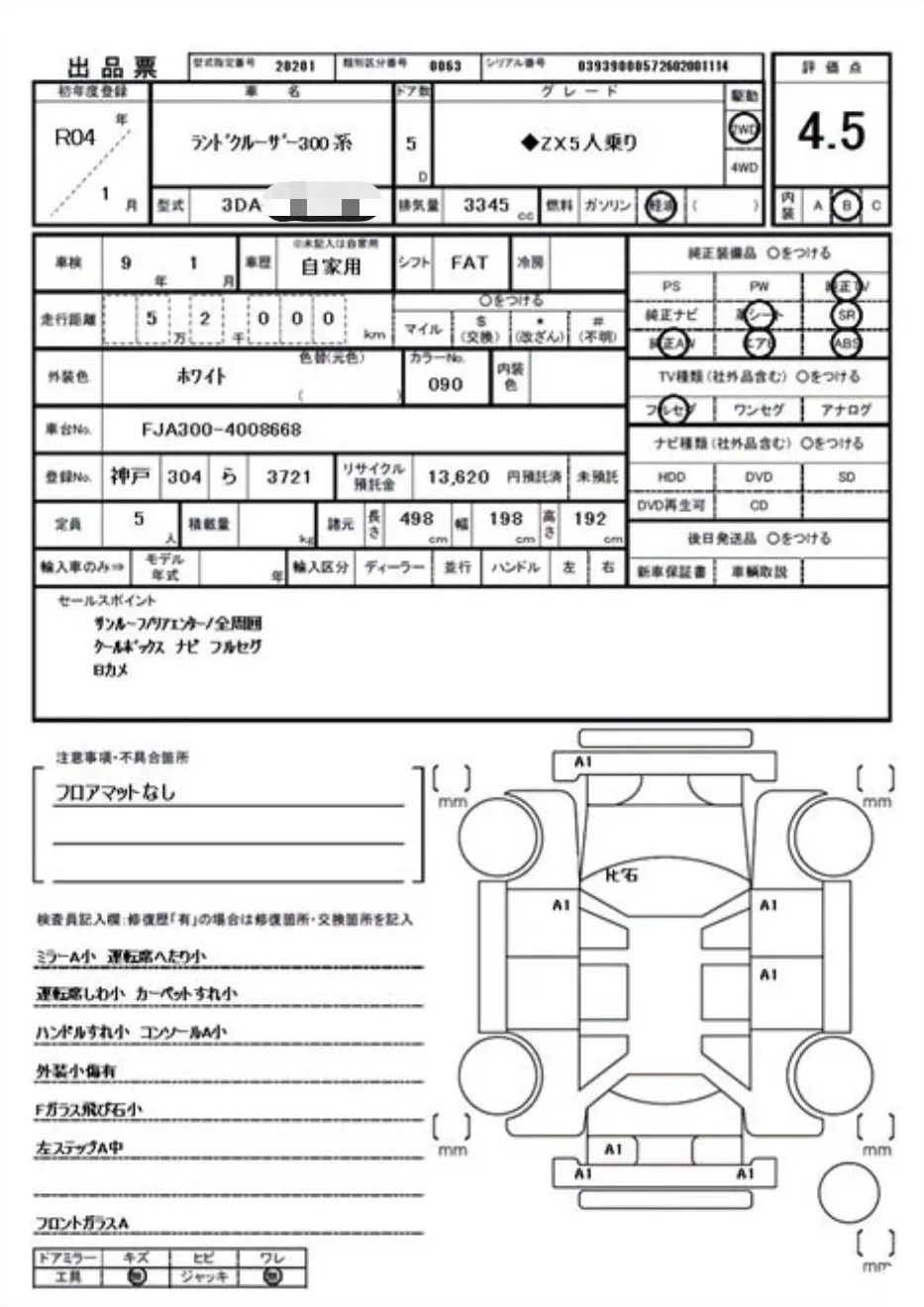
Almost every Japanese used car passes through an auction, where the auction house's own inspector grades it and writes it up on one sheet. It is the most honest record of the car you will ever see, because it was written before anybody in Kenya had a reason to sell the car to you. That is also why it is the document most often edited.
The overall grade, from S for nearly new down to R for repaired
The interior letter: look for A or B; C is tolerable
Every mark on the body, panel by panel: scratches, dents, repaints, replaced parts
The mileage on the day of the sale
How the car was used: privately, as a rental or by a company
Flood, fire and frame damage, which the inspector must declare
The inspector's own notes: smells, leaks, noises and repairs
How to tell a genuine sheet from an edited one
Get it from the auction record. Ask for the sheet as the auction house issued it, not a photo of a printout. An importer who bids for you sees it before the auction.
Match the chassis number. The chassis number on the sheet must be the one stamped on the car and printed on the export certificate, character for character.
Match the lot and the sale. A real sheet names the auction house, the lot number and the sale date. Together they find the car's record.
Look for signs of editing. A grade box in a different type from the rest, blurred or retouched figures, or a sheet with no handwriting at all.
Compare it with the car. The marks on the body map should be on the car in the photos, and the mileage should suit its age and its interior letter.
Our free chassis number check shows which model, engine and years a chassis number belongs to, so you can see at once whether it matches the car you are being offered.
04 Inspection
Step 4: Have the car inspected independently
The auction sheet records what an inspector saw in a few minutes on auction day. An inspection by someone working for you tells you how the car drives today, and what has happened to it since it was sold.
If the car is still in Japan
The auction sheet is your first inspection, and QISJ inspects the car again before it ships. For a second opinion before it leaves, we can arrange an independent inspection by JEVIC, JAAI or EAA at a charge. When the car lands, inspect it against the sheet and its photographs before you sign for it.
If the car is in Kenya
Take it to an independent mechanic of your own choosing, and pay for the inspection yourself. It costs a small fraction of the price of the car, and the mechanic's report gives you something to negotiate with.
What to ask the mechanic to check
Engine
Start it cold. Look for smoke, oil leaks and coolant loss, and listen for knocks or ticking. Fresh paint or new bolts on the engine mean work that the sheet should mention.
Gearbox
Every gear, up and down, in traffic and on an open road. Slipping, a delay before it engages, or a judder from a CVT is an expensive repair.
Suspension, steering and brakes
Knocks over bumps, a pull to one side, vibration under braking and uneven tyre wear all point to worn parts or a car that has been knocked out of line.
Airbags and warning lights
Every warning light should come on with the ignition and go out once the engine runs. An airbag light that stays on, or never lights at all, can hide a deployed airbag that was never replaced.
Underbody
On a lift: rust, bent or welded chassis members, and silt or tide marks that point to a flood. Light surface rust is normal on cars from Japan's snowy north; holes are not.
Body and paint
Uneven gaps between panels, overspray on rubber seals, and paint that is thicker on one panel than the next are the marks of a repaired accident.
A diagnostic scan
A scan of the car's computers shows stored fault codes, and on many cars a mileage figure held in a module that is harder to change than the dashboard.
A proper road test
At least twenty minutes, in town and at speed, with the air conditioning on. Most faults only show once the car is warm.
05 The papers
Step 5: Check that every paper tells the same story
Each document about the car is written by someone different: the auction house, the Japanese authorities, the inspector, the shipping line, KRA and NTSA. When they all agree, the car is what it is said to be. One mismatch is reason enough to stop.
Export certificate
Issued in Japan when the car's Japanese registration is cancelled for export. It gives the chassis number, the model code, the engine size and the date of first registration, the date KEBS counts the car's age from.
QISJ Certificate of Roadworthiness
The pre-shipment inspection Kenya requires, with the chassis number and the mileage on the day it was inspected.
Bill of lading
The shipping line's receipt for the car: the vessel, the port of loading, the chassis number and who the car is shipped to.
Invoice
From the company you are paying, in its registered name, with the price and the chassis number. An invoice that names no chassis number does not say which car you paid for.
KRA customs entry
For a car already in Kenya: proof that its import duty was paid. A car that was never cleared can be seized, whoever owns it now.
NTSA logbook
The registered owner, the chassis and engine numbers, and any joint owner. A bank named as joint owner means the car is still being paid for.
What must match, on every paper and on the car
The chassis number
On the auction sheet, the export certificate, the inspection certificate, the bill of lading, the invoice and the logbook, and on the plate on the car itself.
The year of first registration
The same on the auction sheet and the export certificate, and within Kenya's limit.
The model code and the engine size
A 2.0 litre car sold as a 2.5, or a model code that belongs to another trim, is not the car you were offered.
The mileage
The auction sheet, the inspection certificate and the odometer should tell one story. A reading lower now than at the auction is a clock that has been wound back.
The colour
A colour that differs from the sheet means the car has been resprayed. Ask why.
For a car already in Kenya, search its registration number on NTSA's eCitizen portal before you pay. The search shows who the car is registered to. If the seller's name is not on it, or a lender is listed with them, the car is not yet theirs to sell.
06 Scams
Step 6: Know the red flags of a car scam
Scams around imported cars follow a few patterns, and they are easier to see coming than to undo. Any one of these is a reason to slow down. Two together are a reason to walk away.
No auction sheet
Or only a photograph of one. A car that went through an auction always has a sheet, and a seller with nothing to hide sends it.
Checks are discouraged
"No need to inspect it", "trust me", "the papers come later". An honest seller expects you to check, and makes it easy.
A price far below the market
A deal too good to be true is set that way on purpose: it brings buyers who hurry and skip the checks.
Mileage too low for the car
A low reading on a car with a worn steering wheel, pedals and seats, or an interior letter of C or worse, does not add up.
Papers that do not match
A chassis number, year or engine size that differs between the documents and the car should stop the sale.
Pressure to pay now
"Another buyer is ready", "the price ends tonight". Urgency is how a scam stops you thinking. A real car can wait a day.
Payment to a person
A company that asks you to pay a personal account, or a phone number, is not paying the money into the company.
New bank details by message
An email, WhatsApp or SMS saying the account has changed is the most common fraud of all. Check by calling the company yourself.
A sheet that looks edited
Blurred figures, a grade in a different type, a sheet with no handwriting. A genuine sheet has nothing to retouch.
"The logbook will follow"
For a car in Kenya, the logbook should be in the seller's name before you pay, and transferred to yours when you do.
07 Payment
Step 7: Pay safely, in stages, to a company account
Even when every check has passed, how you pay decides whether you can get your money back if something goes wrong. These habits cost nothing and close the doors most frauds use.
Pay a company, into its own account
By bank transfer to an account in the company's registered name. Never cash, and never a person's account or phone number. Ours are two accounts in the name CARDOJO IMPORTS LTD, at Co-operative Bank and NCBA, listed on our Bank details page.
Confirm the account on a call you place
Before every transfer, call the company on the number on its own website, not one from the message, and read the account number back. Our accounts never change, and the only other place we give one out is on a call you placed to +254 705 500 055.
Pay in stages, never everything up front
For an import, each payment should follow a step you can see. With us, $200 opens the live auction and $1,000 lets us bid, the $200 counting towards it, and both are refundable until we begin buying your car. The rest follows against the purchase invoice once the car is won, and every later payment against an invoice of its own. Our deposit terms set out each stage.
Get an invoice and a receipt for every payment
Each one should show the amount, the date, the company and the chassis number. Every document we stamp carries a code you can check on our Verify page: if the details there differ from your copy, the copy has been changed.
Keep everything in writing
Messages, emails, the auction sheet, the photographs, the invoices and the receipts. If a dispute ever comes, they are your evidence.
In a private sale, pay as the logbook moves
Buying from a person in Kenya, make the payment and the NTSA transfer at the same sitting. For a large sum, an advocate can hold the money until the transfer is done.
08 Delivery
Step 8: Clear, register and collect the car
The last step turns paperwork into a car you can drive. For an import it happens at Mombasa and with NTSA; for a car already here, it is the transfer of the logbook. Our guide to importing a car from Japan takes the import side step by step.
Customs at Mombasa. KRA works out the duty from the car's Current Retail Selling Price (CRSP), reduced for its age, and adds import duty, excise duty, VAT, the IDF and the RDL. A licensed clearing agent lodges the entry. How the duty is calculated, with an example.
The KEBS check. The car is checked at the port against its QISJ certificate.
Registration with NTSA. Number plates and a logbook in your name. Check every detail on the logbook against the export certificate the day you receive it.
Insurance. Cover the car before it goes on the road, from the moment it is yours.
Inspect it on handover. Walk round the car with the auction sheet and the photographs before you sign for it, and note anything new in writing, such as damage in transport.
Checklist Before you pay
The final checklist before you buy
Run through this before any money leaves your account, whether you are importing a car or buying one here.
The car meets Kenya's rules: first registered within eight years, right-hand drive, and a QISJ certificate.
The auction sheet came from the auction record, and its chassis number is the car's.
The grade suits the price: 4 or better with an interior of A or B, C tolerable; an R only with clear notes on the repair.
The mileage agrees on the sheet, the inspection certificate and the car.
The export certificate matches: chassis number, model code, engine size and year.
The car has been inspected by someone working for you, or by the auction and QISJ for an import.
The logbook is in the seller's name, with no lender listed, for a car in Kenya.
None of the red flags in Step 6 are present.
You are paying a company account, confirmed on a call you placed.
You hold an invoice and a receipt for every payment, each with the chassis number.
Cardojo Imports How we protect you
How we keep your purchase safe
Every check in this guide is one we make on every car we sell or import, and the ones that need you, we make easy.
The auction sheet before you bid, translated into plain English, with what we would worry about.
A written landed price in shillings before you pay anything.
A deposit you can get back until we begin buying your car.
Two bank accounts that never change, both in the name CARDOJO IMPORTS LTD.
Every invoice against a chassis number, and every stamped document checkable on our Verify page.
Every stage on your dashboard, from the auction to the logbook in your name.
Four account for most losses: a car that fails Kenya's import rules and is refused at Mombasa, accident or flood damage that was hidden, mileage that was wound back, and payment fraud, above all bank details changed by a message. Each step in this guide closes one of them.
Yes, if the checks are made for you in Japan. The auction sheet is written by the auction's own inspector, QISJ inspects the car before it ships, and an independent inspection can be added. Buy through an importer you can visit, pay in stages, and inspect the car against its sheet when it lands.
Trust the documents more than the description. "Accident free" and "low mileage" mean nothing until the auction sheet, the export certificate and an inspection say the same. A good dealer will show you all three without being asked twice.
A grade of R or RA means the car was repaired after an accident. It can still be good value when the notes say what was repaired, the work was done well and the price allows for it. Walk away from damage to the frame or pillars, and from any seller who sold an R grade car to you as accident free.
Yes. Ask for the chassis number and the auction sheet first; an honest seller gives them before any money moves. With us you see the sheet before we bid, and the deposit stays refundable until we begin buying your car.
Search its registration number on NTSA's eCitizen portal to see who it is registered to, ask for the logbook and the KRA customs entry, match the chassis number on both to the car, and have an independent mechanic inspect it and road test it before you pay.
A bank transfer to an account in the company's registered name, confirmed on a call you placed to the number on its website, paid in stages as the car moves, with an invoice and a receipt for each payment that name the chassis number.
Do not pay. Call the company on the number on its own website and ask. Our two accounts never change; bank details in our name that differ from our Bank details page, even by one digit, are fraud.